
Free Destiny Matrix Calculator

Enter your date of birth. Your full Matrix of Destiny chart — all 80+ nodes, chakra table, genealogical programs and life purpose — is generated instantly.

✦ Your Birth Date
Here's a confession — when I first came across the term "Destiny Matrix," I thought it was some kind of sci-fi marketing gimmick. A rebranding of numerology with better aesthetics. And honestly? Part of me still thinks that's a fair critique. But then I sat down with my numbers and went quiet for a while. Because some things are uncomfortably precise.

What exactly is the Destiny Matrix?

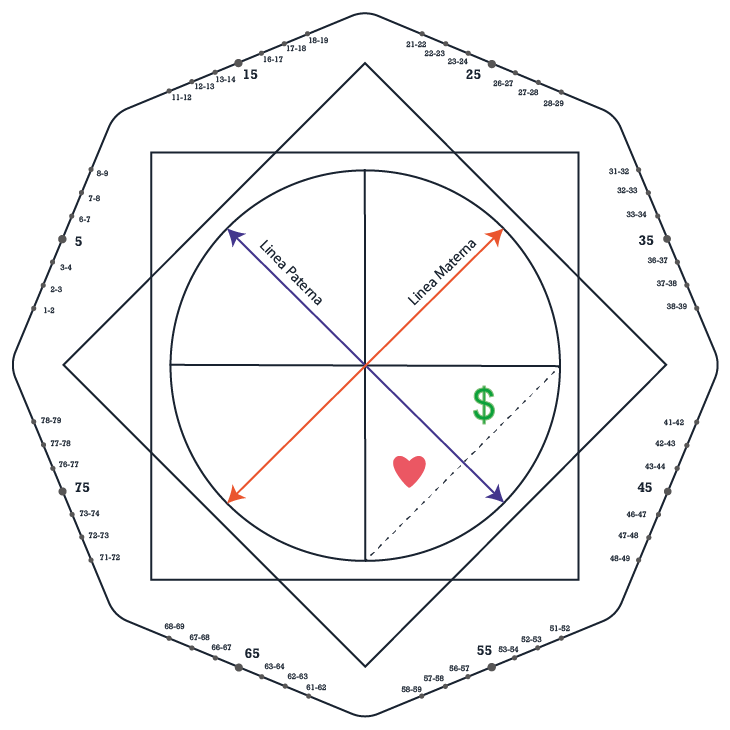
The Destiny Matrix — also called the Matrix of Destiny — is a numerological system built around the 22 Major Arcana of the Tarot. It was developed by Natalia Ladini, a Russian esotericist, sometime in the early 2010s, and it spread through Eastern Europe like wildfire before making its way westward. The core idea is deceptively simple: your date of birth contains a complete code. Your karmic blueprint, encoded in seven digits, mapped onto a geometric structure that looks like two overlapping squares — an octagram — inscribed within a circle.

Each position on that octagram corresponds to something. Your personal purpose, your social role, your spiritual mission, your ancestral programs — both paternal and maternal lines. The system claims to read all of it from nothing but a birthdate. No time required. No birthplace. Just day, month, year.

That simplicity is, depending on who you ask, either its greatest strength or its most suspicious quality.

The 22 Arcana and why that number matters

The Tarot's Major Arcana runs from 0 (The Fool) to 21 (The World). But in the Destiny Matrix system, values run from 1 to 22 — and any number calculated above 22 gets reduced by adding its digits together until it lands back in range. So a 23 becomes 2+3=5. A 36 becomes 3+6=9. Nothing escapes the circle.

Each Arcanum carries meaning. The Emperor. The High Priestess. The Tower. Strength. These aren't random mythological flavors — within the Destiny Matrix framework, they represent archetypal forces that shape how you move through the world. Arcanum 13 (Death, though practitioners tend to bristle at that name) doesn't mean literal doom. It means transformation so complete that what existed before simply can't continue.

Whether you believe the cards themselves are sacred or just ancient psychological projections doesn't really change how the system functions. The math is the math.

How the chart is actually calculated

Let's use a real example — someone born on May 15, 1990.

Day: 15. Month: 5. Year: 1990 → 1+9+9+0 = 19.

From these three seed values, the system generate a cascade of derived numbers. Your personal center (the sum of day + month + year, reduced if above 22). Your four cardinal points — positioned at north, south, east, west on the octagram. The midpoints between them. The genealogical lines. The chakra axis. The purpose triad. By the time the full chart is rendered, you're looking at 80+ distinct numerical positions, each one feeding into and derived from the original three.

It's actually elegant. Deeply interconnected in a way that feels less like guesswork and more like… a language with its own grammar. Even if you're skeptical, the internal consistency is hard to dismiss.

What the chakra table is telling you

One section of the Destiny Matrix output that surprises most newcomers is the chakra correspondence table. Seven energy centers — Muladhara through Sahasrara — each mapped to three numerical values: physical, energetic, and emotional expressions of that particular chakra's influence in your life.

Muladhara (root) relates to your material reality, body, survival instincts. If your numbers here skew toward the more challenging Arcana — say, heavy 13s or 18s — the system interprets that as karmic weight in your foundational sense of safety. Conversely, the higher centers (Ajna, Sahasrara) relate to intuition, destiny patterns, and what the tradition calls "egregores" — collective thought-forms that you participate in or are shaped by.

Sounds abstract, right? But practitioners typically walk through this section in a very practical way. "You have a 7 in the emotional column at Anahata" becomes a conversation about relationships, how you process love, why you keep attracting (or pushing away) a particular kind of person.

Genealogical programs — the ancestral thread

Perhaps the most philosophically interesting part of the Destiny Matrix is the genealogical programs section. Two rows — paternal line, maternal line — each expressed as three Arcana. The premise is that unresolved energetic patterns get passed down. Not metaphorically. Concretely, bodily, behaviorally.

This isn't as fringe as it sounds. Transgenerational trauma research — Bessel van der Kolk's work, the ACE studies, even some epigenetics research — has quietly been building a scientific case for inherited pattern transmission. The Destiny Matrix doesn't claim to be science. But it's doing something adjacent to what therapists of the Bert Hellinger school have been mapping for decades: that families carry wounds, and those wounds move forward in time until someone names them.

The matrix gives those wounds numbers. Whether that's meaningful or just a very elaborate mirror — you'll have to decide that yourself.

Personal, Social, and Spirit Purpose — the real question

The three-purpose structure at the bottom of the chart is where most people spend the most time. And understandably so.

Personal Purpose is what you're here to work through for yourself — the inner growth arc, the karmic lessons that are uniquely yours. Social Purpose is the role you play in the lives of others, across the gendered polarity (historically framed as masculine/feminine expressions within relationships or community). Spirit Purpose is the single number at the summit — the overarching mission that unifies the other two. The big one.

It's not unusual for people to have a Spirit Purpose in an Arcanum they fear or struggle with. Someone with The Tower (16) at the top of their purpose axis has, in a sense, been assigned to mastery of upheaval. Of sudden change. Of radical reinvention. Heavy number, but arguably a fascinating one. Definitely not a comfortable one.

Is the Destiny Matrix "real"?

I keep getting asked this, and I keep giving the same unsatisfying answer: depends on what you mean by real.

Is it a scientifically falsifiable system with peer-reviewed evidence? No. Absolutely not. Don't let anyone tell you otherwise.

Is it a coherent symbolic framework that, when interpreted by a skilled practitioner, seems to generate genuinely useful insights about a person's psychology, relational patterns, and core conflicts? That, based on the experiences of a remarkable number of people — including some quite rational, empirically-minded people — appears to be yes. Often, surprisingly yes.

The framework works the way myths work. Not as literal description of events, but as structure that helps humans locate themselves within a larger story. And humans are, among other things, story-seeking machines. We've been that way for longer than any written system of numerology or tarot. The Destiny Matrix is perhaps just a newer vocabulary for a very old human need.

How to use this calculator

Enter your date of birth. That's it. The calculator generates your complete chart instantly — all 80+ positions, your chakra table, your genealogical programs, your three-tiered purpose structure. The octagram diagram uses the same color-coded node system used by professional Matrix practitioners, with the original reference chart overlay visible beneath the positioned values.

Start with your center value (n30 on the chart — the yellow node at the heart of the design). That's your core personality number, what the system sometimes calls the "personal comfort zone." Then check the four cardinal points: your social mask, your hidden self, your karmic mission upward, your earthly mission downward. Then the corners of the inner square — the diagonal energies that give your chart its particular texture.

You don't need to interpret all 80+ nodes in one sitting. Nobody does. Even professional Matrix readers typically work through a chart in multiple sessions. Start with the center. Sit with it. See if it rings true. Then expand outward, layer by layer, the way you'd read a complex map — not all at once, but following the roads that grab your attention first.