Symbolism & Imagery
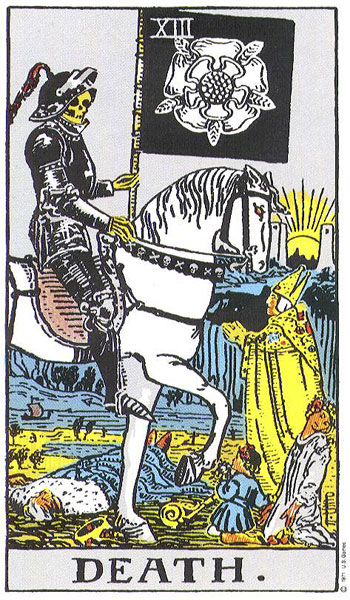
The black knight rides a white horse — which is already doing something unexpected, because white horses are not what you associate with this figure. He carries a black flag bearing a white rose, the flower of purity, of things that bloom precisely where you wouldn't expect them. Before him the ground is littered with the figures of mortality: a fallen king, a bishop still praying, a child offering flowers, a young woman who looks away. All of them in his path. None of them — not the crown, not the vestments, not the youth, not the innocence — exempt.
The river in the background flows toward an opening between two towers where the sun is visibly rising — or setting, depending on your disposition. Scorpio and Pluto govern this card: depth, transformation, the capacity to go into the absolute darkness and come back changed. The number 13 frightens people in most Western contexts, which the card seems aware of and entirely unbothered by. The skeleton underneath the armour is what all the other figures on the previous cards have in common. That's not a threat. It's a fact.
The Death Upright
The General Meaning
Not physical death. Almost never. The card has a reputation that exceeds its literal meaning by quite a margin, and professional readers will tell you this reliably and honestly — the Death card is about endings, transitions, the absolute closure of a chapter. And yes, that can feel like death. The loss of an identity, a relationship, a period of life, a version of yourself you'd grown attached to — these things have genuine weight, and the card doesn't minimise them. But what it also carries, consistently, is that image of the sun between the towers: something on the other side. Transformation requires the ending. You cannot carry everything into what comes next.
Love & Relationships
A relationship ending — or a relationship transforming so completely that what continues barely resembles what existed before. Both are the Death card in romance, and it's worth sitting with the distinction. Sometimes what's ending is the relationship itself, and the card is acknowledging what you already know but haven't said aloud. Sometimes what's ending is a particular dynamic or phase within the relationship, and something new is becoming possible precisely because the old form has been released. Either way, resistance to the ending tends to prolong the pain without changing the outcome. The card has a certain patience about this.
Career & Work
The end of a career chapter — a job, a role, a professional identity that has run its course. Redundancy, resignation, the quiet recognition that a path you've been on for years is no longer yours. This can feel catastrophic in the moment, and the card isn't pretending otherwise. But the Death card in career positions tends to appear specifically when what's ending has genuinely already ended on some level — when the external event is catching up to an internal reality that's been true for longer than it's been acknowledged. The new thing cannot start until the old one is actually over.
Money & Finances
The end of a financial era — the loss of an income stream, the dissolution of a financial arrangement, the closure of something that had been generating resources. This is rarely comfortable. But the Death card in financial contexts also tends to arrive when the current approach has reached its genuine limit and continuing it would be less productive than the discomfort of letting it go and starting again from a more honest position. The question worth asking: is this ending, or is this ending, and what's the difference in how you'd respond to each.
Health & Wellness
A profound physical transition — recovery that requires genuinely leaving behind old patterns and behaviours rather than returning to a prior state. Sometimes the Death card appears in health readings to indicate that what's being called a 'setback' is actually a transformation: the body clearing something it no longer needs, a system shifting to a new equilibrium. It also appears in readings about serious illness with appropriate gravity — this card is not reassuring in those contexts in conventional ways, but it does carry the consistent message that endings are also thresholds.
Spirituality
Ego death — the dissolution of an identity or a fixed sense of self that you'd organised your life around. This is perhaps the most profound spiritual experience available, and it is not comfortable. The Death card upright in a spiritual reading marks the moment when a framework, a belief system, a way of understanding yourself or the world, has to be released because it's no longer adequate — because you've outgrown it, or because life has made it untenable. What replaces it isn't yet visible. The space between the old form and the new one is genuinely dark. The sun is still going to rise between those towers.
The Death Reversed
The General Meaning
Resistance to an ending that is happening anyway. The Death card reversed is the energy of clinging — to a situation, a relationship, a phase of life, a version of yourself — that has already passed in all but the formal sense. And there is real cost to this kind of resistance. Not moral cost, not judgement — just the practical cost of spending enormous energy maintaining the appearance of something that no longer exists, which leaves very little available for whatever is trying to begin. The card reversed is asking: is holding on to this serving anyone, or is it just postponing something that's going to happen regardless?
Love & Relationships
Refusing to let a relationship end that has already ended. Or — a different but related pattern — staying in a relationship that has transformed beyond recognition without acknowledging the transformation, pretending nothing has changed because the alternative requires an honesty that feels too costly. The Death card reversed in romance can also indicate someone unable to complete a grieving process after a loss: the relationship has ended, the other person has moved on, but the internal attachment remains as vivid and consuming as if nothing had concluded. Time does not automatically resolve this. The release has to be chosen.
Career & Work
Staying past the end. The job that is genuinely over — not improvable, not renegotiable, not a situation that will turn around — being stayed in because leaving requires a kind of death, a surrender of identity and income and routine that feels like more than can be managed. The reversed card in professional contexts also sometimes indicates an inability to move on from a professional failure or loss: the business that closed, the career that didn't work out, held as an identity wound that hasn't been processed. You cannot build the next thing while still living inside the ruins of the previous one.
Money & Finances
Financial decisions made out of fear of change — specifically the change of losing what currently exists. This can look like refusing to exit a losing position because exit acknowledges the loss as real. Or maintaining a financial arrangement that doesn't work because restructuring it requires confronting the fact that it hasn't been working. The Death card reversed in financial readings is pointing at the gap between what is being maintained in appearance and what is actually true, and asking whether the effort of maintenance is generating anything of value.
Health & Wellness
Physical stagnation — a health situation stuck in patterns that are no longer helpful but haven't been released. Old coping mechanisms, approaches to treatment that have been tried past their point of usefulness, a body being kept in a state by habit and fear rather than genuine support. The reversed card can also indicate a specific fear of physical change or decline — a difficulty accepting the natural transformations of the body over time, which tends to generate more suffering than the changes themselves. Some things the body does cannot be resisted into not happening.
Spirituality
Refusing the transformation that's trying to happen. A spiritual crisis being suppressed rather than passed through — the old framework breaking down and the response being to shore it up rather than allow the dissolution. The Death card reversed in a spiritual reading often accompanies a period of genuine dark night of the soul where the person is fighting the darkness rather than moving through it, which prolongs it considerably. The resurrection the card promises — and it does consistently promise it — is on the other side of the ending, not adjacent to the refusal of it.