Symbolism & Imagery
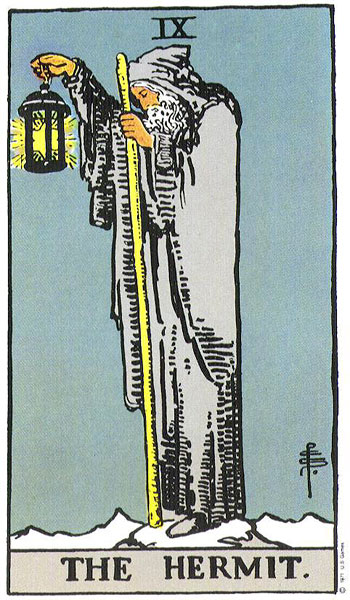
He stands alone on a mountain peak in the dark — which already tells you something. Not lost. Not stranded. Arrived. The lantern he holds up contains a six-pointed star, the Seal of Solomon, and it illuminates only a small circle of ground immediately in front of him. Not the path ahead, not the valley below, not the road back. Just here. Just now. The grey cloak blends into the mountain; the long staff is something between a walking aid and the kind of object you lean on when you've earned the right to stop moving for a moment.
Virgo governs this card — the sign of discernment, of separating what matters from what doesn't, of attending to the microscopic details that tell the real story. The number 9 is completion, the full cycle nearly turned. The mountain isn't arbitrary either: wisdom, in this tradition, lives at altitude. It requires the climb. And then, crucially, it requires the willingness to stand there alone with what you find when you arrive.
The The Hermit Upright
The General Meaning
Not everyone wants to hear this one. The Hermit upright is asking you to stop — not temporarily, not 'until things settle down', but genuinely and deliberately. To step back from the noise, from the obligations, from the constant incoming stream of other people's needs and opinions and demands on your attention, and to spend some significant time with your own thoughts. This isn't antisocial behaviour; it's an essential form of maintenance that most people chronically defer. The card appears when the inner life has been neglected long enough that it's starting to affect the quality of everything else.
Love & Relationships
A period of meaningful solitude, which is not the same as loneliness even when it feels like it. The Hermit in a romantic context sometimes signals a necessary withdrawal from the relational field — time spent figuring out what you actually want, who you actually are when you're not performing for or adjusting to another person. If you're single, the card isn't saying nothing will happen; it's saying the work available right now is internal, and rushing into connection before that work is done tends to produce the same results you've already had. In an established partnership, one or both people may need more space than usual. That can be held without it meaning something's wrong.
Career & Work
Independent work, specialised knowledge, the kind of expertise that comes from having gone very deep into a particular thing over a long time — all of these are Hermit territory professionally. This isn't the card of the team-building exercise or the collaborative whiteboard session; it's the card of the researcher, the consultant, the person brought in because they've spent a decade becoming genuinely good at one specific thing. Right now, working alone or in significant quiet is more productive than any amount of meeting. The answer you're looking for is more likely to come in the margins of the calendar than during it.
Money & Finances
A period of careful, somewhat austere financial assessment. Not crisis — just the deliberate choice to pull back from spending in order to understand, clearly and without distraction, where things actually stand. The Hermit in a money reading can also indicate income through knowledge work: teaching, advising, mentoring, consulting. Whatever you've accumulated through years of paying careful attention to something is the financial asset most worth developing right now. The value of what you know is probably being underestimated.
Health & Wellness
Rest. Not the managed kind where you're still half-working while horizontal — actual, genuine, disconnected rest. The kind where you're not trackable. The Hermit in health readings tends to appear when someone has been pouring energy outward for so long that the interior reserves are approaching empty, and the replenishment being recommended isn't a long bath and an early night but something more structural: a real withdrawal, a real pause. It also commonly appears around turning points in chronic conditions — the moment when something that has been slowly building finally gets the focused quiet attention it needed.
Spirituality
This might be the most naturally spiritual card in the deck, because what it describes is essentially the beginning of any genuine inner life: the decision to go inside rather than outside for answers. The Hermit's lantern illuminates his own path, not yours — that's the point. Other people's maps and frameworks and traditions are useful up to a point, but at some stage the question becomes what do you find when you go in by yourself, without the guides, without the community, without the comfort of consensus. That discovery is the Hermit's offering. It's not always a comfortable one.
The The Hermit Reversed
The General Meaning
Isolation that has stopped being intentional and started being habitual. Or, just as often, the opposite: such a terror of solitude that the person is in constant motion, constantly surrounded, systematically blocking any quiet that might allow a thought to surface that they're not ready for. Both are the reversed Hermit. The card inverted tends to appear when the balance between inner and outer has gone significantly off — either too much withdrawal or an absolute refusal of it, and either way the underlying driver is the same thing, which is avoiding something specific.
Love & Relationships
Loneliness — actual loneliness, the kind that sits underneath the busyness or the numbness or the perfectly curated social presentation. The Hermit reversed in a romantic context can indicate someone who has retreated so thoroughly from connection that intimacy now feels almost inaccessible, even when they want it. Or it describes the person who reaches for external connection compulsively, as a substitute for the inner companionship they haven't yet learned to provide themselves. Neither version will resolve through finding the right person. That particular work has to happen first.
Career & Work
Isolation that has become counterproductive — the expert who has gone so deep into their specialism that they can no longer communicate with anyone outside it, or the person working alone not because they work better that way but because connection has become difficult and this is easier. The reversed Hermit at work can also indicate paranoid withholding of information or knowledge: the belief that sharing what you know diminishes your value, which tends to produce its predicted result. Sometimes it's simply burnout from too long without adequate human contact in the professional environment.
Money & Finances
Hoarding behaviour dressed as prudence — financial decisions made from a scarcity mindset so entrenched that even genuine security doesn't register as security. Or the other version: such complete disconnection from the practical realities of money that basic financial hygiene has been neglected almost as an act of philosophical principle. The reversed Hermit in money readings asks a direct question: is this relationship with resources actually working, or has a particular stance toward money — however philosophically coherent — become its own obstacle?
Health & Wellness
Complete disconnection from the body's needs — not through suppression exactly, but through absence: the person who has retreated so far into their own interior that basic physical maintenance has dropped off the agenda. Meals skipped, appointments not made, rest treated as optional. The reversed card can also indicate depression of the withdrawn, low-energy variety — not the loudly distressed kind but the quietly erosive kind that's easy to mistake for introversion until it's been going on for quite a long time. Reconnecting with other people, counterintuitively, may be the first step back.
Spirituality
The inner journey taken too far inward, or taken in bad faith. Spiritual solitude becomes avoidance when the 'introspection' never surfaces anything uncomfortable, never produces anything that requires changing actual behaviour, never encounters real resistance. The Hermit reversed in a spiritual reading sometimes indicates someone who has made a virtue of isolation in a way that is secretly quite convenient — it excuses them from the demanding, friction-generating work of being in relationship with other people, which is, as it happens, where most of the actual spiritual development tends to occur.