Symbolism & Imagery
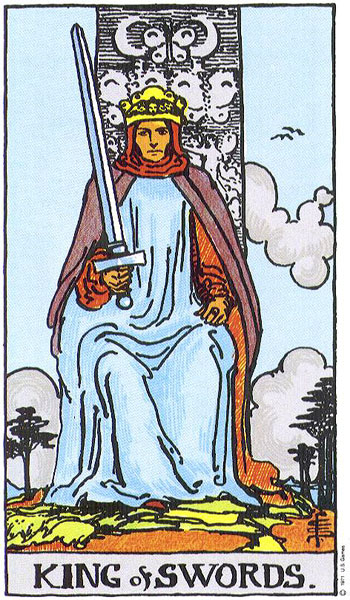
He sits facing directly forward — the only court card in the entire deck to do this, or close to it. The others turn slightly, their gaze directed toward something at an angle. This King looks at you. The sword is held upright in his right hand, not at rest, not lowered, not sheathed anywhere comfortable — just vertical, steady, pointed at the sky. His throne is stone, minimal, the decorative elements limited to subtle butterflies and crescent moons worked into the back. The sky behind him has clouds but they are behind him, and his expression contains none of the weather's movement.
He wears a blue robe under purple — intellect coloured, contemplation underneath authority. The small green trees at the base of the card suggest that life continues below the altitude of this throne. The butterflies on the throne are Air's symbol, transformation through thought. The crescent moons suggest the unconscious is present in the design even for the suit most committed to the conscious mind, which is a choice worth noting. He knows the moon is there. He has thought about it carefully. He has filed it in the appropriate place. The sword is vertical. The gaze is direct. The judgment is formed and ready to be delivered.
The King of Swords Upright
The General Meaning
Intellectual authority that has earned its own confidence — not arrogance, which looks similar from a distance but is easily distinguished up close by the absence of genuine rigor. The King of Swords represents the mind operating at full maturity: analytical, ethical, capable of holding complex information and producing clear judgment from it without the distortions of self-interest or emotional attachment to a preferred conclusion. This card appearing in a reading suggests that the situation requires this quality — either you're bringing it, or you should seek it from someone who has it, or both.
Love & Relationships
Love approached with clarity rather than projection — which is either exactly what's needed or the thing the romantic situation is specifically asking to develop further, depending on where you're starting from. The King of Swords in romantic readings isn't the passion card; it's the genuine understanding card. The partner or potential partner described here is someone who will tell you what they think, keep their commitments, apply real thought to the relationship's complexity rather than defaulting to feeling alone, and expect the same intellectual honesty in return. Some people find this deeply attractive. Others find it somewhat arid. Both responses are information.
Career & Work
Professional authority grounded in actual expertise — the kind of leadership that earns credibility through demonstrated judgment rather than positional power. The King of Swords in career readings points to a period where analytical clarity is the dominant professional asset: the report that cuts through the accumulated confusion to the accurate picture, the decision made correctly because the thinking behind it was genuinely rigorous, the assessment delivered without flattery or softening that changes the direction of the project before it went further in the wrong direction. This is what intellectual authority looks like in operation.
Money & Finances
Financial decisions made from principled analysis rather than market excitement, personal feeling, or the enthusiasm of whoever is doing the selling. The King of Swords in money positions brings to financial situations the same quality he brings everywhere: unimpressed by packaging, focused on the substance, unwilling to proceed without understanding the actual terms. He reads the contract. All of it. He asks the question that reveals whether the person on the other side of the table actually knows what they're talking about. These are the most unglamorous and most consistently useful financial skills available.
Health & Wellness
The advocate who knows the system and works it effectively — the patient who has done genuine research, who asks precise questions, who understands the difference between what a test can reveal and what it can't, who doesn't mistake professional confidence for infallibility and doesn't mistake their own internet research for clinical expertise either. The King of Swords in health readings values the intelligent, informed engagement with healthcare over both passive deference and reflexive resistance. He is neither an easy patient nor a difficult one. He is a competent one, which is rarer.
Spirituality
The contemplative intellectual tradition — the theology that takes its thinking seriously, the philosophy of religion that follows arguments wherever they lead, the approach to spiritual questions that begins with the conviction that truth is coherent and that careful thought can approach it. The King of Swords spiritually is the person for whom intellectual honesty is itself a spiritual value: who would rather hold a difficult true thing than a comfortable false one, who brings the same rigor to examining their own spiritual claims that they bring to examining anyone else's. The sword is up next to the proposition. The proposition is better for having been tested.
The King of Swords Reversed
The General Meaning
Intellectual authority becoming intellectual tyranny — the analysis correct and the delivery destructive, the judgment sound and the manner of rendering it cold enough to foreclose the possibility of it being received. The King of Swords reversed is also sometimes the manipulation of intellectual authority: using the appearance of rigorous thinking to justify positions that originate in self-interest or ideology rather than in honest assessment. The sword pointed forward rather than upward — at a person rather than at a problem. Both patterns are worth recognising on sight because both tend to present as simply being right about things.
Love & Relationships
Emotional unavailability through over-intellectualisation — the relationship managed at the level of logic and analysis in ways that prevent genuine intimacy from having the conditions it needs. The reversed King of Swords in love readings describes the partner who can articulate the dynamics of the relationship with extraordinary precision and cannot, somehow, be present in it in the way that presence is required: the person who has thought very carefully about what love means and experiences very carefully constructed difficulty actually feeling it. It can also indicate using intellectual superiority as a dominance strategy in a relationship — correcting, critiquing, deploying knowledge in ways that establish hierarchy rather than connection.
Career & Work
Judgment exercised from bias while presenting as objectivity — perhaps the most practically significant version of this reversed card in professional contexts. The King of Swords reversed in career readings indicates the senior figure whose decisions present as analytically rigorous and serve undisclosed interests, the expert whose expertise has calcified into ideology, the leader who has confused the internal experience of certainty with the external fact of being correct. Can also indicate simple professional coldness: technically precise management that disregards the human cost of its precision in ways that eventually cost more than the precision saved.
Money & Finances
Financial decisions that feel intellectually rigorous and are actually post-hoc rationalisations for something decided on other grounds. The reversed King of Swords in money positions is the investment that was wanted for emotional or ego reasons and justified with analysis afterward, the financial strategy that is correct by the model and wrong about the model's assumptions, the expert opinion that is delivered with complete authority and is confidently, expensively wrong. It can also indicate over-analysis as paralysis: so much intellectual examination of financial options that decisive action has become impossible and the cost of indecision is now material.
Health & Wellness
Excessive clinical detachment from one's own body — treating physical experience as something to be diagnosed and managed rather than listened to and inhabited, the self-imposed remove of the person who is very good at understanding health information and not particularly good at actually feeling how they are. The reversed King of Swords in health readings can also indicate a medical professional or authority figure whose delivery has become dismissive in ways that are preventing the patient from establishing what they actually need to know. Precision without compassion in healthcare. Effective at a technical level. Harmful in ways that don't show up in the notes.
Spirituality
The intellectual approach to spiritual life having become the alternative to spiritual life rather than a path toward it — the theology that substitutes for encounter, the philosophy that circles the question without ever sitting in it, the rigor that has never, despite its complete internal consistency, produced anything that felt like contact with what it was rigorously examining. The reversed King of Swords spiritually eventually faces the question that all the thinking cannot answer to his own satisfaction: whether the analysis has been wrong, or whether the question was always going to require something other than analysis. Both conclusions are available. The sword is still pointing up. At some point it needs to come down.