Symbolism & Imagery
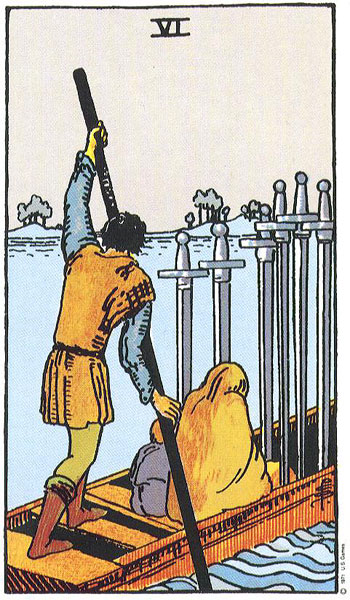
A ferryman poles a small boat across still water. A woman sits in the prow, cloaked and turned away — her posture not exactly grief but something adjacent to it, the contained weight of someone who has left something behind and hasn't yet arrived somewhere new. A child sits beside her, small and present in a way children are when they don't yet have the vocabulary for what's happening. The six swords stand upright in the front of the boat, blades embedded in the hull — heavy cargo, still present, going with them. They're not being discarded. They're being transported.
The water on the right side of the boat is choppy. The left side is glassy and calm. The boat is crossing that boundary right now, in this moment — mid-passage, neither in the turbulence nor fully in the peace yet. The ferryman works steadily. Nobody in the boat is steering; he is. The landscape toward which they move is indistinct, not dramatically promised, just quieter than where they came from. And perhaps that's enough. The swords are the thoughts, the wounds, the mental patterns that travel with you when you move — they don't get left behind automatically. They come along. The question is whether the water ahead is calmer than the water behind.
The Six of Swords Upright
The General Meaning
You're in the middle of passage. Not where you were, not yet where you're going — the particular in-between that feels like nothing is happening and is actually one of the more significant phases of any transition, because it's where the direction gets set. The Six of Swords upright is quiet relief after difficulty, the beginning of mental clarity returning after the turbulence that preceded it. The swords are still in the boat. The problems haven't vanished. But the water is calmer and the direction is away from what was no longer workable, which is something. Often it's quite a lot.
Love & Relationships
Moving away from a painful relational period — either literally (leaving a relationship that wasn't sustainable) or internally (a shift in emotional orientation within a relationship that was stuck). The Six of Swords in love readings carries the specific quality of post-turbulence recovery: the volume coming down, the nervous system slowly recognising that the emergency has passed, the gradual possibility of something more settled. If this marks an ending, the card is neither celebrating nor mourning it — just noting that the direction of travel is away from turbulence and that the destination, while not yet distinct, will be quieter.
Career & Work
A professional transition in motion — leaving a role, a company, an industry, or simply a particularly difficult phase of a career — and being mid-crossing rather than at either shore. The Six of Swords professionally is not the dramatic exit card; it's what happens in the weeks after the decision was made and before the new situation has fully established itself. The mental cargo comes along: the habits of the previous environment, the residue of any conflict there, the self-perception shaped by that context. Worth knowing that you're carrying it so you can notice when you set it down.
Money & Finances
Financial transition — moving away from a period of financial difficulty toward something more stable, even if stable isn't yet visible in the numbers. The Six of Swords in money readings has a quiet optimism that doesn't oversell itself: things are moving in a better direction, the acute crisis appears to be behind rather than ahead, the water is becoming navigable. It can also indicate literally moving — change of residence, relocation costs, the financial dimension of physical transition. The swords in the boat serve as a reminder that even positive financial change carries real weight while it's happening.
Health & Wellness
Recovery — the passage from unwell to well, which is not as linear a journey as it sounds and which this card represents with more honesty than most. The Six of Swords in health readings marks the phase where the worst has passed but the crossing isn't complete: the energy not yet fully restored, the system still recalibrating, the person neither ill nor fully themselves. Mental health specifically — this card often appears during the middle period of recovery from depression, anxiety, or burnout, when the quality of the water has changed but the shore isn't visible yet. The ferryman is still poling. The direction is right.
Spirituality
A spiritual crossing — the transition between frameworks, between communities, between phases of interior development that can't be hurried and can't be skipped. The Six of Swords spiritually is the liminal passage: the person who has left one way of understanding the world and hasn't arrived at the next, travelling with the old concepts still present (the swords in the hull) because new ones haven't yet replaced them. The water ahead is quieter. The work is staying in the boat long enough to get there, rather than trying to swim back to the shore that was familiar even though it was turbulent.
The Six of Swords Reversed
The General Meaning
The passage stalled, or the resistance to leaving making the crossing harder than it needs to be. The Six of Swords reversed often indicates someone who knows they need to move on and can't quite complete the departure: leaning back toward the turbulent shore, returning repeatedly to what was left, finding that the mental cargo won't stay in the boat but keeps requiring active management during the crossing. It can also indicate external obstacles to transition — circumstances making the move physically or practically difficult. Either way, the boat isn't making the progress the upright version suggests.
Love & Relationships
Difficulty moving on — whether that means inability to leave a relationship that's clearly over, or inability to leave the interior experience of a relationship that has already ended externally. The reversed Six in love readings is honestly one of the more common draws for people in the middle of post-relationship grief: still on the turbulent water, the direction nominally away but the wake pulling back, returning in thought or in contact to what was supposed to be behind them. It's not a character flaw. It's the pull of attachment. The card is noting the pull rather than condemning it, while suggesting that the resistance to crossing is costing something.
Career & Work
Transition impeded — either a move that's not happening as planned, a departure that keeps getting delayed, or a professional shift that technically occurred and psychologically hasn't. The reversed Six of Swords in work contexts can also indicate someone who has moved to a new environment and is carrying the old one so completely that the new one can't quite establish itself: bringing the habits, the paranoia, or the self-image of a previous difficult role into a situation that would, if perceived freshly, be rather different. The swords are still in the boat and they're taking up more room than they should.
Money & Finances
Financial transition delayed or reversed — the expected improvement plateauing or declining again, the costs of moving proving higher than anticipated, the passage taking longer than the original calculation suggested. The reversed Six in money positions can indicate difficulty getting to the calmer water because the turbulence is persisting past the point where it was supposed to have subsided. It can also indicate someone moving backward financially — returning to a situation they'd left, taking on a dynamic they'd exited, finding the old water is rougher than they remembered it feeling before.
Health & Wellness
A recovery that isn't progressing linearly — setbacks during a period that should be improvement, the discouragement of feeling worse again after feeling briefly better. The reversed Six of Swords in health readings is honest about the non-linearity of healing: the relapse, the plateau, the moment where the boat seems to have stopped making headway or is drifting back toward the choppy side. It's not permanent. But it requires adjusting the expectation of what recovery looks like — particularly for mental health, where the graph is never a clean line upward and the reversed Six often marks the day when that becomes viscerally apparent.
Spirituality
Resistance to spiritual transition — clinging to the previous framework even when it's clear it no longer holds, or unable to settle into a new orientation because the passage has been longer than expected and patience has worn through. The reversed Six of Swords spiritually can also indicate a kind of interior turbulence that won't calm: meditation that won't still, prayer that keeps hitting the same wall, spiritual practice that seems to be going nowhere. The destination is still there. The ferryman is still poling. But the water isn't cooperating and the crossing is taking longer than the situation seems to have been designed for.