Symbolism & Imagery
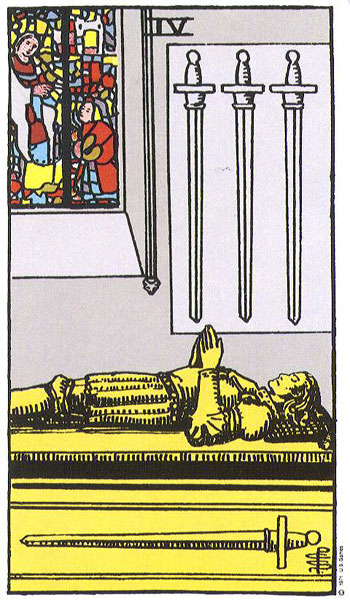
A knight lies horizontal on a tomb effigy — hands pressed together in prayer or simply held still, armour on, face serene. Three swords hang on the wall above him. One lies beneath him along the full length of the tomb, point outward. The posture is so close to death that the stained glass window behind him — depicting a figure kneeling before another in some act of supplication or blessing — provides the only immediate evidence that life is still the operative condition. Even there, though, the image is still. Everything in this card has stopped moving. Intentionally.
The fours in tarot are about structure and stability, and in the Swords suit this takes a form that surprises people: not the stability of accomplishment but of deliberate cessation. The three swords on the wall remain — they haven't been resolved, sheathed, or dissolved. Whatever conflict or difficulty they represent is still present in the room. The knight is just not engaging with it right now. The one sword kept close is enough for protection while the others hang out of immediate reach. The church setting suggests the rest is more than sleep — it's sanctuary. A chosen withdrawal into something quiet and protected while the interior reconstitutes.
The Four of Swords Upright
The General Meaning
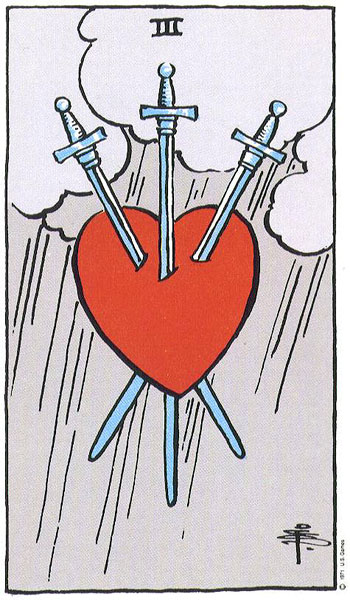
Stop. Not forever, not in defeat — just stop, right now, for long enough to let the system recover. The Four of Swords upright is the tarot's least ambiguous prescription, and it's one people consistently resist because stopping feels like losing and the suit of Swords has been running very fast for several cards now. The Three happened. Whatever it was, it happened, and the mind has been in it since. This card is the room after that: quiet, still, with the door closed. The swords are still on the wall. They'll be there when you're ready. Right now the only correct action is not-acting.
Love & Relationships
Space in a relationship — needed, earned, or both. The Four of Swords in love readings can indicate a period of deliberate withdrawal that isn't disconnection: one or both partners stepping back from the intensity of the relational dynamic to recover some individual equilibrium. After conflict, after significant change, after the kind of emotional expenditure the Three of Swords sometimes represents, this rest is what makes returning to each other possible rather than impossible. It can also indicate someone who needs more solitude than the relationship currently provides and is beginning to feel the deficit.
Career & Work
The project paused, the sabbatical taken, the sick leave finally requested. The Four of Swords in professional readings indicates that rest is not just warranted but necessary for the work to continue at the level it's been functioning — or for it to function at all. Productivity culture is particularly bad at making space for this card. The result, typically, is that people don't take the Four of Swords voluntarily and eventually encounter its reversed version instead, when the body or mind simply stops without asking permission. Better to choose the pause than to have it chosen for you.
Money & Finances
Financial consolidation rather than expansion — a period of holding steady, not making new moves, letting what's already in motion settle before adding more complexity to the picture. The Four of Swords in money positions can also indicate a deliberate step back from financial stress: choosing not to obsess over the numbers daily, finding a structure that handles what needs handling and then setting it aside mentally for a period. This is not avoidance. The two-of-swords is avoidance. This is the card of the person who has done what can be done for now and knows it.
Health & Wellness
Rest as treatment. Full stop. Not as supplement — as the primary intervention. The Four of Swords in health readings is the most direct card in the deck for physical recuperation: the post-surgery recovery, the convalescence, the sleep that's being prescribed rather than hoped for. It also covers mental health recuperation: the period of deliberate reduced stimulation after a breakdown or burnout, the withdrawal from the demands of normal life while something more fundamental is repaired. The knight keeps his armour on, which suggests readiness isn't being abandoned. He's just being still inside it for now.
Spirituality
Contemplation. The specifically non-productive form of spiritual practice — the sitting that isn't building toward anything, the silence that isn't emptying to make room for insight, just silence, held for its own sake. The Four of Swords spiritually is the retreat, the vigil, the monastery that certain people need for intermittent periods and almost never give themselves permission to have. The stained glass window suggests the sacred container is still present even in the stillness. Especially in the stillness, maybe. The card isn't asking you to do anything with this. Just to stop, for once, and let stillness do whatever stillness does.
The Four of Swords Reversed
The General Meaning
The rest is ending — either because you've recovered enough to re-engage, or because external pressure has ended the pause before the recovery was complete. Both are possible and the card doesn't clearly distinguish between them, which is useful information in itself. The Four of Swords reversed asks whether the return to activity is chosen or imposed, and whether what drove you to the tomb-pause has been genuinely metabolised or simply spent long enough that forward motion is possible again without it having been resolved. The swords are still on the wall. Worth checking whether you're ready for them or just no longer lying down.
Love & Relationships
Re-engagement after a period of distance — either the return from necessary space into renewed connection, or the push back into relational activity before the individual recovery was complete. The reversed Four in love can mean a relationship resuming real communication after a cooling-off period, which can go beautifully if the rest was productive and less beautifully if what both people feel is mainly pressure to return to function. It can also indicate restlessness within a necessary withdrawal: the difficulty of being still when the relationship feels like it requires active management and the interior is telling you it still needs the quiet.
Career & Work
Returning to professional activity — sometimes with genuine renewal behind the return, sometimes a little earlier than ideal. The reversed Four of Swords in career readings can indicate burnout that's been patched rather than resolved: taking the long weekend when the situation required the month, returning to full capacity on paper while something essential is still running on reserves. It can also indicate someone who finds genuine rest impossible — who can't stop working even when the correct move is obvious, for whom the horizontal effigy position would feel like failure rather than sanctuary. Both patterns tend to cost more over time than stopping would have.
Money & Finances
Financial re-engagement after a period of deliberate consolidation — stepping back into active management, making new decisions, beginning the next move. The reversed Four in money positions asks whether the consolidation period produced the clarity it was supposed to: whether stepping back from financial anxiety gave you genuine perspective or just temporary relief that hasn't changed the underlying thinking. The swords are coming back down from the wall. It helps to know what you're planning to do with them before they're in your hands.
Health & Wellness
Rest cut short, or the restlessness that prevents adequate recovery. The reversed Four of Swords in health contexts is the card of the person who returns to full activity two days after they should have, who skips the final week of recuperation because they feel better enough and can't afford the absence, who medically completes the course of treatment without actually completing the recovery. The body is often slower to restore than the mind's sense of readiness suggests. This card in reversal gently notes that the feeling of being ready and the reality of being ready are not always the same assessment.
Spirituality
Difficulty sustaining stillness — the practice interrupted, the retreat ended too soon, the contemplative period abbreviated by the weight of ordinary demands. The reversed Four of Swords spiritually often appears when someone knows they need inner quiet and can't quite access it: too much mental noise, too many external demands, an interior landscape that has forgotten what silence feels like from the inside. The effigy position is available. The question is whether anything has been allowed to be quiet long enough to find out what lives there beneath all the motion.