Symbolism & Imagery
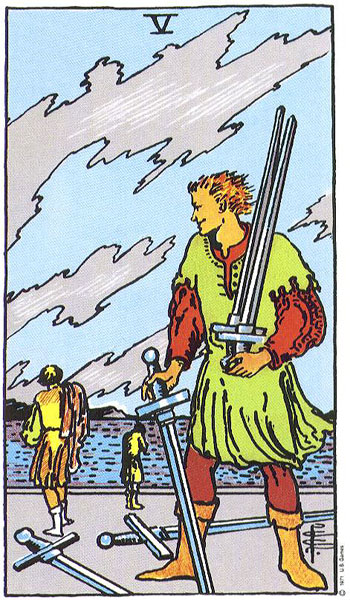
Three people on a beach under a troubled sky. The foreground figure holds three swords and has two more beneath his feet — he's collected the weapons. He's looking back over his shoulder at the other two, who are walking away in defeat, one with shoulders slumped in a posture of loss so specific it's almost painful. The victor's expression doesn't read as triumphant. This is one of the Rider-Waite deck's more psychologically nuanced compositions: nobody looks happy. The person who won is watching the people he defeated walk away, and whatever he got from the encounter, satisfaction doesn't appear to be on the list.
The sky is tempestuous — yellows and greys gathering in ways that suggest the weather's relationship with the conflict is approving of nothing. The sea is restless. The swords collected are physical (all five are present and accounted for), but the actual casualty here is harder to hold — trust, perhaps, or a particular kind of relationship, or the self-image of the figure watching the retreating backs who perhaps believed he could win and keep everything else intact simultaneously. The five of any suit is the disruption number, and here the disruption is specifically to the assumed cost-benefit of conflict. He won. Something was lost anyway.
The Five of Swords Upright
The General Meaning
A conflict concluded, but not cleanly. The Five of Swords upright forces the question of what victory actually costs — whether what was gained in the winning justified what was spent or surrendered to get there. It can indicate being the person who won (at what cost?) or the person who lost (what now?), or the observer who watched the whole thing and is trying to understand what just happened. The card doesn't moralize about any of these positions exactly; it's more interested in the aftermath than the score. Pyrrhic victories are still victories. This one is asking you to look at what's in your hands and what's walking away before you decide how to feel.
Love & Relationships
Conflict in which someone emerged clearly on top and the relationship is now absorbing the consequences of that. The Five of Swords in romantic readings is one of the less comfortable draws for obvious reasons — it marks moments of power imbalance in love, when aggression, manipulation, sharp words, or simply needing to be right has produced a winner and a loser in a context that was supposed to be a partnership. The person who lost the argument might also have lost something less recoverable. The person who won the argument is watching them walk away and, if they're honest, doesn't feel great about it either.
Career & Work
Office politics, workplace conflict, a competitive dynamic that someone won and others definitively lost. The Five of Swords professionally is the promotion secured through manoeuvring rather than merit, the credit taken from someone who produced the work, the argument won in the meeting at the cost of an ally. It can also indicate being on the receiving end of this — having lost a professional conflict in a way that stings, surveying what was taken, deciding what comes next. The card is clear-eyed about the fact that workplace environments generate this dynamic regularly and that navigating it requires honesty about what happened rather than the pretence that it didn't.
Money & Finances
A financial conflict or negotiation in which advantage was seized — possibly legitimately, possibly not. The Five of Swords in money positions can indicate gaining financially through competitive or aggressive action, or losing out in exactly those circumstances. It can also describe a financial situation where the mechanics of winning (the deal closed, the negotiation concluded in your favour, the asset secured) have cost something harder to quantify — a relationship, a reputation, a piece of self-respect. Worth noting whether the cost was worth the gain before the accounting closes.
Health & Wellness
Self-defeating behaviour — the specific health pattern of doing things that undermine your own wellbeing while telling yourself you're fine or that this is just how it is. The Five of Swords in health readings sometimes indicates winning the argument with yourself about whether to address something while the original something continues unchecked. It can also appear in contexts of chronic conflict: the health consequences of sustained stress, combative environments, or the particular physical costs of aggression maintained over time. The body tends to keep score of conflicts the mind has declared concluded.
Spirituality
The ego winning a battle it probably shouldn't have entered. The Five of Swords spiritually points to the moment when the need to be right, to defeat the other position, to dominate the discourse, takes precedence over the question of what's actually true — within spiritual communities, within one's own interior discourse, within a practice that has somehow become competitive rather than connective. It can also indicate walking away from a spiritual community after conflict: the defeated figure on the beach who has lost something they perhaps underestimated while they had it. The card is asking what was actually worth fighting for.
The Five of Swords Reversed
The General Meaning
The aftermath of conflict beginning to be processed rather than simply survived. The Five of Swords reversed is often about what comes after the wreckage: the attempt at reconciliation, the post-conflict reckoning with what was actually gained and lost, the possibility of conversation across the damage. It can also indicate an ongoing conflict finally ending — not necessarily cleanly or with declared winners, but simply stopping, which sometimes is the only resolution available and is still better than continuation. The reversed position here sometimes also indicates avoiding conflict that should be had: letting things slide rather than addressing them, which is not resolution but deferral.
Love & Relationships
An attempt to repair after conflict — or the beginning of the honest conversation about the damage that was done and whether what remains is workable. The reversed Five in love can indicate a couple moving toward reconciliation after a serious falling-out, navigating the question of whether trust can be rebuilt after it was clearly broken. It can also describe someone who has lost a relationship through aggressive or self-serving behaviour and is beginning to understand what their role in that was. Remorse is present in the reversed Five, usually. The question is whether it's followed by anything.
Career & Work
The end of a workplace conflict — either through resolution, through one party leaving, or through the entire situation becoming too exhausted to continue. The reversed Five of Swords professionally can also indicate reckoning with the reputational cost of having been perceived as the aggressor in a conflict: navigating the aftermath of winning in a way others witnessed as disproportionate, or finding that the victory was less clean than it appeared because the person defeated took information, relationships, or goodwill that was worth more than the prize. Conflicts at work rarely end cleanly and the reversed Five is honest about that.
Money & Finances
Financial dispute resolution — a negotiation concluded, a legal matter settled, a financial conflict that has run its course. The reversed Five in money positions can indicate receiving less than was hoped from a resolution process that was emotionally expensive to undertake. It can also sometimes describe the relief of financial conflict simply ending, even without a clear win, because the cost of continuing was exceeding the value of what was being contested. There's a specific version of this card that describes walking away from a financial fight because winning wasn't worth what winning would cost. That's not always defeat. Sometimes it's sense.
Health & Wellness
Recovery from conflict-related health impact — the body beginning to release what it's been holding in a sustained state of high alert. The reversed Five of Swords in health readings can indicate nervous system regulation returning after a period of chronic stress or interpersonal aggression, the kind of recovery that takes longer than expected because the body has become so accustomed to the elevated state that baseline feels unfamiliar. It can also sometimes indicate the end of a pattern of self-sabotage: not fixed, not fully resolved, but the direction of travel changed enough to notice.
Spirituality
Reconciliation with what was lost in spiritual conflict — either with a community, a belief system, or one's own interior. The reversed Five of Swords spiritually can mark the beginning of understanding a painful departure from a spiritual community or practice: what drove it, what was real in the conflict and what was ego, what, if anything, of the original connection survives. It can also indicate the gradual dissolving of the need to be right about spiritual matters — the recognition that nobody wins the argument about transcendence and that the arguing may have been less about truth than about comfort, authority, or something older entirely.